

Posts by bluebirdmama
Outdoor Education
Living in the Pacific Northwest means that the winter is dark, gray, rainy, and wet. As you can imagine, we have rubber boots and rain gear so that we can still get outside in the middle of winter, but I will be honest with you: we really don’t do it a lot. Come summer though, we practically live outside. The days are long and bright. The weather is warm, not hot enough for my liking, but we make up for that with the lack of bugs. There are plenty of opportunities for fun in our backyard and around our lovely corner of the world. There are so many amazing things about outdoor play: the opportunity to blend play with exercise and fresh air, the ability to create unique and imaginative play spaces with fewer restrictions than you might have indoors, the possibilities for open-ended play because there are fewer toys outdoors. One of my favourite things about outdoor play is the way that being in nature inspires learning. From the time he could walk, Rain loved bugs. This is probably where his outdoor education began as we started turning over rocks in the back yard to find pill bugs, snails, banana slugs, ants, ladybugs and spiders. He learned their names and where they were most likely to be found. He has an observation jar (clean peanut butter jar with holes in the lid and the labels removed) where he keeps the specimens he catches so he can watch them. We do enforce one observation jar rule that all critters be released at bedtime each day so they don’t starve or miss their mothers too much. From there he started learning plant identification. Daddy is an arborist so we tend to notice and talk about trees quite a bit. By the time Rain was two and a half, he knew how to spot a weeping willow, a mountain ash (rowan tree) and a Japanese maple. Some great books to incorporate when learning about trees and shrubs are the Flower Fairies series by Cicely Mary Barker. We have the Flower Fairies of the Autumn book which has lovely illustrations and poems for Oak tree, Rowan tree, Dogwood, Blackberry, Rosehips and more. He would point and call out the names of trees he noticed when we drove around town. There are many tree related learning activities you can use to continue the conversation after you move indoors or as you explore the forest. You can: Talk about the shapes of leaves. Gather a whole bunch of different ones and paint them and use them to make prints on paper. Discuss the difference between conifers and deciduous. A fun story to listen to at the same time is The Evergreens by Odds Bodkin (find it at your local library on CD). Compare the size of a seed to the size of a mature tree. Talk about the different types of tree seeds/flowers there are: samaras, catkins, cones, acorns or other nuts like horse chestnuts etc. (Oh and by the way, they aren’t called pine cones if they’ve fallen from a hemlock or a cedar tree. My husband has pointed this out to me more times than I care to admit.) You can also compare the size of cones from different evergreen trees. Identify the shapes of different trees. Are they triangular, oval shaped, bell shaped, globe shaped? Talk about the life cycle of plants over the seasons – this is particularly obvious for trees in fall and spring of course. When Rain was 3.5 years old we moved to a new house where we had a yard that was big enough to plant a veggie garden. This created many new opportunities for outdoor learning as he helped us plant seeds. He learned that they need warmth and water to grow, that when they first sprout there are usually only two leaves and that sometimes the sprout is still wearing the seed case like a hat. (A great book that talks about seeds in called A Seed is Sleepy). He learned about transplanting bedding...
Read MoreBriefly May
What I learned in May 2010: If either of my children intends to pursue dance in the long term I have to be prepared for a ridiculous schedule of rehearsals at recital time. Rain has to be at dance 11 times over the course of two weeks, which involves hauling a squirming toddler inside and trying to corral her while wrestling Rain into dance shoes and ushering him into class in a sea of parents and preschoolers in a room the size of a closet. Run I mean, fun! Making butter from raw cream straight from the farm is not as straightforward as using store bought whipping cream, but tasty nonetheless and Rain loves kneading bread. I love working at the midwifery clinic as office administrator and when I put my mind to it, I CAN write a bio. I love Sir Ken Robinson, love his TED talks and I am currently loving his new book, The Element. I would sew a lot more if I could leave my sewing machine set up permanently. I can get a lot of sewing done while my daughter naps and having all the pieces cut and ready to go ahead of time makes sewing much more enjoyable. The weather in May is much more unpredictable than I would have predicted. Hello summer? Where are you? The steps to being awesome are easy to come up with but following them is not. Burt’s Bees avocado butter pre-shampoo hair treatment makes my hair happy. Rain is a comedian, an artist and has a flair for showmanship: Rain came out of the bathroom calling “Mom, you have to come see the treat I made you!!” I replied, “Promise me it’s not poop.” He said, “I promise.” As I entered the bathroom, he pulled a towel off the towel bar with much fanfare to reveal his masterpiece: a drawing of himself picking his nose! I can assure you that I was NOT able to keep a straight face as I explained that we do not write on the walls of our rental...
Read MoreBread & Butter
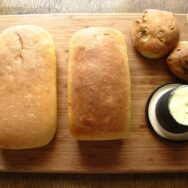
A few months ago, a potter friend of ours made Aaron a baking stone so we could try the artisan no-knead bread recipe from Mother Earth News. This went amazingly well but we’ve waxed and waned in our bread making over the months. We recently started up again. I wanted to try a bread that required kneading because it’s been suggested in the Waldorf school meetings that I have been attending that kids love to knead bread. I’ve tried the French Bread recipe from my Better Homes & Gardens cookbook a few times with varying degrees of success. Similarly, I’ve been wanting to try making our own butter. I remember fondly making butter as a kid by shaking it in a jar for, um, forever and I remember how delicious it was. We’ve been trying to make more and more food ourselves and I thought this would be a fun one to add. So last Tuesday (the only day the kids and I are home together the whole day without outside commitments like work, preschool or dance class), we decided to tackle homemade bread and butter. This time we used the Basic White Bread recipe from The Joy of Cooking. As predicted by our Waldorf friends, Rain loved kneading the bread. It was so fun that we forgot to take a picture. But here he is with the dough ready for the first rising: While that was rising, we started on the butter. You have to warm the cream to room temperature and meanwhile, stick the bowl you will be using in the fridge to cool it. Then you pour the cream into the bowl and whip it with your hand mixer. Notice the cloth on the counter. I did an awful lot of counter wiping as the cream sprayed everywhere, including all over the front of my sweater which later that evening, smelled like sour milk. I recommend an apron. The first stage is called the frothy stage: The next stage is meant to be the whipped cream stage, where it should get thick and start forming peaks. After this stage, it should get even thicker and start crumbling. The cream we were using came from a local farm and was unpasteurized. As a result, I do not know it’s exact fat content. It certainly didn’t seem as thick as a store bought whipping cream but resembled a cereal cream or half and half. We I whipped for a long time – Rain got bored and left – but it just wasn’t thickening into whipped cream as it should have. I whipped longer and longer until I noticed that there appeared to be curds floating in the foam. On closer examination, I discovered the curds were yellow. The longer I whipped, the more of these curds appeared so I just went with it. Then I strained off the buttermilk. I didn’t get nearly as much butter as I would have if I had used whipping cream. According to the internets, 1 quart of cream should have delivered up 1 Lb of butter. I used a quart of cream and got about 1.25 cups of butter. The next stage is to wash the butter. If any of the buttermilk remains in the butter, it will go bad quite quickly. To do this, you put the butter in your blender with some cold water. You blend it and then pour off the water. You repeat this process as many times as it takes for the water to be clear when you pour it off. Once you have cleaned the butter, the last thing to do is to squish it all together to form a solid chunk. I used a combination of a rubber spatula and my hands to do that part. It was a bit of a strange process because there was some water drops still in the butter and of course, water and oil don’t mix but the butter was soft so it was hard to squeeze the water out of it. I did manage in the end though....
Read MoreAre YOU awesome?
I’ve lost track of the numbers of people I’ve met who have no real sense of what their individual talents and passions are. ~ Sir Ken Robinson Earlier this month, I lamented my inability to write a bio. Being between projects makes it difficult, but so does being the mom of young children. With all our focus on the needs of other people in the household we may find that we don’t know ourselves very well anymore. The time away from work also messes with our identity a little, especially if we begin to reassess our goals, dreams and values in light of our new roles as parents. The longer we are away from the workplace, the more we begin to notice that our society tends to define people by what we do and what we are good at. And if you spend the majority of your time conversing with preschoolers and wiping noses and bums, it’s easy to lose your grip on what your other talents may be. But perhaps the problem runs deeper. Perhaps it wasn’t just born out of motherhood? I have a sneaking suspicion that even before I had children, I was easily counted in the numbers of people who have no real sense of what their individual talents are. This got me wondering why so many of us don’t know what makes us awesome. Why is it so hard for us to answer these questions: What makes me awesome? What makes me feel awesome? What are my awesome skills? Do you know who you are? One of the reasons is that some of us might not know ourselves very well to begin with. As young people, we can take for granted who we are. In our teen years, we may be trying on personas but it comes closer to experimentation that to genuine self-knowledge. Twenty-somethings can get caught up accomplishing things: checking off relationships, marriage, house-buying, career-building, and having children on that inner to-do list. We might never really take a moment to think deeper about who we are or why we are awesome long enough to actually believe we are awesome. It’s not such a surprise then that this issue still dogs us post-motherhood. Perhaps we’re just more aware that it IS an issue once we have children? Perhaps it’s the first time we’re old enough to think about it seriously? Furthermore, how many of us really make a point of nourishing our relationship with ourselves? Of being our own best friend? If we treated our friends the way we treat ourselves – only hanging out once every six months – it wouldn’t be long before our friends would stop talking to us too. Dr. Daniel Siegel talks about the ways in which meditation and mindfulness activate the same parts of our brains as do attached interpersonal relationships and he goes on to say that these practices are very like becoming our own best friend. Perhaps spending time getting to know ourselves is the first step to discovering our innate awesomeness? But even then, we may still struggle with self-appraisal, with figuring out what makes us unique. Have you found your thing? In his new book The Element, Sir Ken Robinson explains that successful people find themselves in their element. The element is the intersection between what you are good at (your talents) and what you love (your passion). Some of us are good at things that we don’t really enjoy but true success is found when we discover our element. Furthermore, the element also requires that you have the right attitude (a willingness to go for it) and the opportunity. This part seemed really key to me. Your element could very well be surfing but if you live in the desert, you may never find that out. You need both the opportunity and willingness to try surfing if you are ever to discover that it’s your awesome thing. So, by now, maybe you believe that you are awesome at something but you haven’t yet figured out what that thing is. Want to...
Read MoreA Quiet Example

Welcome to the May Carnival of Natural Parenting: Role model This post was written for inclusion in the monthly Carnival of Natural Parenting hosted by Code Name: Mama and Hobo Mama. This month our participants have waxed poetic about how their parenting has inspired others, or how others have inspired them. Please read to the end to find a list of links to the other carnival participants. *** In 2005, we had a baby. We used midwifery care. We had a home birth. We had a son and we did not circumcise him. We used a cloth diaper service. We breastfed. Aaron and I were the first in our group of friends to have kids. At first it was kind of strange and we felt like outsiders among them. Life had changed in that instant, punch-in-the-face kind of way that seems normal among first time parents, and we found ourselves withdrawing from our childless friends. Out of necessity, we hunkered in and learned to parent. Along the way, one-by-one our friends joined us in parenthood. Five years later, nine of the couples that we regularly associated with back then either have kids or are pregnant. In this group of nine couples, seven used (or are using) midwifery care. The two couples that didn’t were pregnant with twins. Only one birth was by cesarean (and it was one of the twin births). Two couples had their babies at home and two more couples are currently planning home births. Surrounded by these people, I often make the mistake of thinking that midwifery care and home birth are more widespread than they are. But when you look at the data, a different picture emerges. According to the most recent reports from the BC Perinatal Health Program, only 5.8% of births in BC were attended by a midwife (versus 78% in our friends), and 29.3% of births were by cesarean section (versus 14% in our friends). In 2007/2008, there were 671 home births out of a total 43,505 births which gives us a home birth rate of 1.5%. If all goes as planned, the home birth rate among our friends will be 44%. Why is it that our group of friends has this vastly different set of statistics for their births? I suppose it is partly demographic. Perhaps we share similar mentalities that would predispose us towards these kinds of choices: cloth diapering, eating organic, and so on. We are friends for a reason. But it’s not like our friends are hippies. Overall, most of our friends are regular people, professionals, home owners. Aaron and I were probably closest to the home birth “type” – you know, living in a bus and sporting dreads and all. When I look at the numbers though and realize how different our group is from the rest of the province, I would like to think that maybe we were a positive example to our friends. I tried not to be preachy but I answered questions when they came our way. I only remember a few conversations and no one has ever said that we influenced them. I don’t take credit for their decisions. After all, I don’t think anyone chooses home birth because their friends did. You have to make that choice for yourself and you don’t make it lightly. You ask questions. You read. You talk to your caregiver. Yet, even knowing one person who has actually had a home birth can demystify it for you. Every single person who uses a midwife or has a baby at home helps to normalize birth options for everyone they know. Even if you never really talk about it you become a shining example that there is another way, that there are choices. So in some small way, I like to think that we did have a role to play, that we were a positive influence among our friends. Maybe when they walked into their first appointment with a midwife and she offered them a choice of birth place, they didn’t brush it off as quickly as they might...
Read More

Recent Comments
No comments to display