


Posts by bluebirdmama
Maybe Montessori
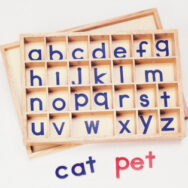
This is Part VII of the series Kindergarten Considerations in which I have been discussing (and wrestling with) the considerations behind the seemingly innocuous decision of where to send my four year old son to school. The next three posts are dedicated to a discussion of our top three options. This post looks at Montessori. Amber from Strocel.com recently pointed out that it’s going to be impossible to find a perfect school and I know she is right. I am aware in some deep recess of my brain that I can’t be too picky. I have to be realistic. I think we all choose the best option for us, for our circumstances. The director of Rain’s preschool has also reminded me (rightly) that no matter what school we choose, it’s going to come down to the teacher whether or not it’s a good fit for him. With that said, let me warn you that in the next few posts I will be picking apart all of our options. Which isn’t to say that I won’t choose one of them in the end. I should add my little disclaimer here that my comments about particular schooling philosophies represent my impression based on preliminary research and reflect our own family educational goals. My comments are not intended to suggest that a particular philosophy may not be the right choice for your family. Montessori A couple of weeks ago I mentioned that we were attending an info session for the local publicly run Montessori program. I went to the evening with an open mind and felt excited about checking it out. I only knew the bare minimum about Montessori. I knew that it had been around for about 100 years, that it was started in Italy by Maria Montessori and that it’s generally regarded as a very good alternative schooling program. I also knew that the children are allowed to roam freely around the room and choose materials to work with as they like. So far so good. The first thing they did at the info session was show us this video to introduce us to the basics of Montessori education. The learning materials and environment are intriguing and beautiful. I was encouraged by some aspects of the philosophy: the emphasis on self-directed learning and the addition of non-academic units like practical life. The staff, teachers and our local society seem sincere, dedicated and earnest. But the reality of the program here didn’t mesh with the fairy tale in the above video. The school, a former middle school, was large and imposing. The room on the second floor, though filled with Montessori materials was utilitarian with only two windows at one end of the room, located above a 3 foot counter. I tried to imagine my son trying to see out the windows or walking to his classroom, through wide corridors and up long flights of stairs. It didn’t feel very accessible to a five year old. In and of themselves those issues could be dealt with. It would only take a few weeks for Rain to get used to the immensity of the place. I feel more bothered by the lack of accessible windows really. But I also think back to when I would pick up my niece from Kindergarten. Everything in that whole wing of her school was kid size: tiny toilets, tiny water fountains, coat hooks at knee level, bright windows. Taylour’s kindergarten reminded me of my own and I wonder how is it that school has changed so much in the last 10 years that we no longer try to approach the child on their level? Moving on though. My impression of the space quickly bled into my impression of the philosophy. Keep in mind that I was there in the evening so I wasn’t able to observe children in the classroom, but to me, the program felt cold. Though the video talks about how much fun the children have while they are learning, we also heard repeatedly that the children would not be playing with the materials;...
Read MoreOn Finding Time

The struggle for time and balance seems fairly typical for most moms, whether working at home or away from home. I’m sure I’m no exception. I’m not a great multi-tasker. I work best once I get into a flow, say after about 20 minutes. Once I’m in that place, it’s very hard for me to shut off until I reach a pre-determined stopping point which tends to be task oriented, not time oriented. I don’t do well with setting the timer and working for X number of minutes. I like to check something off my list. At work I was very good at time management and at completing tasks. Deadlines, projects, to do lists. Yes. I’ve also had an on-again/off-again romance with day planners since First Year uni. I am not completely Type A, but I do have some pretty strong tendencies in that direction. At home, I feel like I’m either scrambling, avoiding, dropping the ball or time wasting. It’s an uncomfortable place to be. Before motherhood it seems we are pulled in fewer competing directions and our commitments have clearly demarcated time slots. Work time is work time. Self time, couple time, friend time can all be fit in around life tasks like cleaning, cooking, sleeping and errands. As a mom, there are no clear time slots for anything. It seems like all of these responsibilities need to happen at once, while caring for tiny dictators. I very rarely get a chance to get into my post-twenty-minute-work groove. I very rarely feel that I am working in my optimal range. I feel like I’m juggling all the time. For a klutz like me that is an incredibly unnerving way to live. My heart rate is shooting up just typing this. Clutter, disorganization, noise. They stress me out. I hold my breath. I feel swept away in a swift moving river and I start to panic. I have coping mechanisms but I haven’t really found answers. I focus on keeping the toys picked up, keeping rooms tidy. I write lists. But I also avoid. I check email, facebook or twitter, rather than trying to write or catch up on bookkeeping because I only have five minutes instead of forty-five. If I were to add up all those five minute chunks in a day, which are generally wasted on social media surfing, I would find I have much more time than I think I do. The reason I do this is because I haven’t yet learned how to break out of my need for compartmentalization. For 8 months, we had a mother’s helper who watched Rain four mornings a week while I worked. This is the closest I’ve come to finding a balance between self, work and mother. The rest of the time, the reality of working at home with kids is very different. I have tried working while the kids napped but if they wake early I often become resentful. I have tried working while the kids play. The task takes longer with the interruptions and in the end I am frustrated and stressed by the mess the kids have created while I was in my supposed work zone. Because of my need to work in that zone, I can get a bit obsessed with my projects. The more I work on a project, the more I want to, the more it occupies my thoughts, the more it competes with my children (especially if I was pulled away before completing a task). I seem to shift continuously between denial of self and selfishness. This isn’t exactly the compartmentalization I’ve been looking for. For me to really feel that I am managing my time in a positive way, I need to be clear about what is work time and what is family time. I want to be more present with my children and more present in my work. This delicate balance isn’t going to be a static place where I can stand still. I expect it will take footwork. I expect I will have to say no to some...
Read MoreLet Them Play

This is Part VI of the series Kindergarten Considerations in which I have been discussing (and wrestling with) the considerations behind the seemingly innocuous decision of where to send my four year old son to school. I had promised to share my thoughts on our options in this post but I got totally distracted by the idea that maybe school isn’t necessary at all. Rain can’t recite the whole alphabet; it still gets a bit jumbled and he doesn’t yet recognize all of the letters. He can recite to 10 when he feels like it and when he tries he can reliably count objects in groups up to 4 or 5. He doesn’t write his name. He wrote the letter R on the back of his Valentines but often elaborated by adding wheels, arms or flowers. I am totally fine with that. Here’s the deal. I have complete confidence in my kids’ abilities. They both demonstrate to me every day that they are very bright. I don’t care what age they learn to write their name or say the alphabet or count or read. I know with 100% certainty that they will do it and at their own pace. There will be plenty of time in the coming years for them to focus on academics and I don’t believe that they will be at a disadvantage from learning to read at 7 instead of 4 for instance. In fact, a recent study from New Zealand has proven that very thing. By age 11, there was no difference between kids who learned to read at 7 and those who learned at 4. “One theory for the finding that an earlier beginning does not lead to a later advantage is that the most important early factors for later reading achievement, for most children, are language and learning experiences that are gained without formal reading instruction,” says Dr Suggate. “Because later starters at reading are still learning through play, language, and interactions with adults, their long-term learning is not disadvantaged. Instead, these activities prepare the soil well for later development of reading.” “This research then raises the question; if there aren’t advantages to learning to read from the age of five, could there be disadvantages to starting teaching children to read earlier (at age 5). In other words, we could be putting them off,” he says. The above passage makes several striking observations in only a few short sentences. First, that the most important factors for later literacy are “early language and learning, while de-emphasising the importance of early reading.” Second, that play is vital for early learning. Third, it raises the question of what harm we could be doing by teaching reading too early. I have heard elsewhere that teaching reading before 11 for instance, shapes our brains in a linear order and can hamper our abilities to think laterally. These three observations alone are reason enough for me to feel relaxed about Rain’s academic career. We’ve got time for Rain to be a kid. We can focus on formal reading instruction in a couple of years. There are so few years in life when we are truly free of pressures, truly free to play. I want him to play, partly because it’s fun and partly because he is learning even while he plays. He is learning about respect, gravity, problem solving, shapes, empathy, conservancy, conflict resolution, following instructions, developing hand-eye coordination and fine-motor skills, and more all day, just by playing and experimenting. Interestingly, educators are starting to chime in about the importance of play. Last year, the Alliance for Childhood published a report, Crisis in the Kindergarten, about the lack of play in Kindergarten in the US. This report explained that there was too much instruction, too much testing, too much homework and not enough child-directed play. A New York Times article on the Crisis in the Kindergarten report discussed the lack of play in classrooms and also touched on some thoughts on creativity that are similar to those of Sir Ken Robinson. Thinkers like Daniel Pink have proposed...
Read MoreTrick of the Light
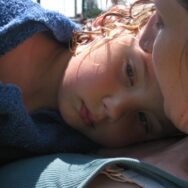
The other day, when I dropped Rain at preschool, he unzipped his coat, found a hook, hung it up, placed his boots neatly underneath and marched confidently off to find something to do. The teacher got him set up showing a younger boy how to use a set of plastic gears. I was amazed at how big he was, how tall, how grown-up, how helpful, how knowing. That night, he had a bad dream. I heard him crying and went to his room. In the dark, I held him. His little body shook and his voice broke with sobs. How like a baby he still was! I smoothed the curls on his sweaty forehead and offered him “a pinch.” His still-dimpled hand found my forearm and methodically squeazed the muscle, just as he used to when he was nursing at 10 months old. How strange that in the dark, in the night, he was still my baby, still clinging desperately to me as I whispered that he was safe. I have this same experience every day with his younger sister Noa. As she giggles and runs after her older brother, how cute and big she seems. How stubborn and determined when they fight, when Rain takes her toy and she defiantly shouts “No!” How like a little girl she is in the day-to-day moments of life. Walking, talking, climbing. Sit down to breastfeed and it’s another story. I trace the curve of her nose, marvel at the downy hair on her cheek, the pout of her lower lip. She sucks contentedly and I try again to memorize her face, just as it is. Suddenly she seems to be my baby again. Her face innocent and newborn-like, despite that her wee head is at least four times bigger than it was the day I first craddled it in my palm. One moment so big; the next so small. Is it a trick of the light? How is it that one moment we’ve finally gotten used to the fact that they are growing up and the next we are once again brought to our knees by the utter tiny-ness and dependence of them? Something shifts and we see how tightly they are still tied to us and then just as quickly the veil is drawn aside and they are running from us, laughing. I am often astounded that children can seem to suddenly cross into a new developmental stage all at once. I’ve seen this in my own children and in my friends’ children. Overnight they seem to shift from floppy newborn to chubby baby, from squirming toddler to running, jumping full-fledged boy. It is breathtaking and always provokes a complex reaction in me: part pride, part shock. There is always the sad surprise that I’ve had to part with the last stage without being asked, without preparation. Suddenly, it’s gone and I’m loving the next stage. How grateful I am to discover that just as suddenly there are momentary lapses into the previous stage. Would it be too unbearable to watch the speed with which our kids grow up if it weren’t for these tiny reprieves? I savour these as best I can. I record them with my senses, in my muscle memory, the weight of their bodies in my arms, the smell of their hair, the whisper of their breath on my cheek. I pack them away, knowing that quickly, suddenly, the light will change and the baby will be gone again. Time gently grants us this fleeting grace as she marches forward. A minute here, a minute there, a ray of sunshine as our babies walk confidently out of our...
Read MoreTake back your holidays from Hallmark

I already had a post written and scheduled for Valentine’s Day…not about Valentine’s Day, but about love in a way. Then I read Amber’s post at Strocel.com about having The Valentine’s Blues. There were a lot of comments echoing her blues and they are generally representative of what I hear over and over. I’ve often felt that way too. My husband used to say the same things but I told him that I thought his attitude was a cop-out. It is what you make it. First, we can lower our expectations. Valentine’s Day doesn’t have to be the most romantic day of the year. Acknowledging our love for each other doesn’t have to be a grand gesture and it doesn’t have to be expensive. We can be satisfied with something thoughtful and heartfelt rather than expecting fireworks year after year. Valentine’s Day can just be an opportunity to tell each other how we feel. We aren’t excused from doing it the rest of the year. It’s just an acknowledgement that we can get busy and forgetful, that we often take our love for granted after many years. It’s kind of nice to have a day set aside to remind us that love is a verb, an action, not a feeling. I feel like why not take that opportunity? Why shun the whole idea just because a lot of it in our culture has gotten warped and twisted? I don’t like the commercialism of Christmas but I can choose to celebrate the holiday in a way that is authentic to me. Secondly, it doesn’t have to be a hallmark holiday. We don’t buy cards, flowers or chocolate. We often do something small and simple. One year, Aaron took red electrical tape and made heart shapes all over Eliza’s ceiling before he left for work so I got a surprise when I got up. That was all he did that day but it was touching and sweet. The next year, he made white paper hearts and hung them from strings. One year, I wrote a 100 things I love about him on tiny slips of paper and hid them for Aaron to find. This year, I’m planning to tape coloured hearts on the floor in a trail leading from beds to hiding spots for some gifts for each family member to discover when they wake tomorrow morning. An (oft-begged for) umbrella for Rain, a pair of shoes for Noa and some import beer for Aaron with little notes about why I love them. There doesn’t have to be anything Hallmark about your holidays. You can choose how you celebrate. You don’t have to fall into the hype and expectations. When I was single, I too felt that Valentine-less angst and that was probably when I felt the most cynical about it. I certainly do understand that it can make people feel left out. Yet, one of my best Valentine’s Days ever was the year that a single guy friend and I decided to spend it together. We exchanged gifts (chocolates and flowers), had an awesome dinner at a vegetarian Indian restaurant and went for a long walk around the seawall in Vancouver. It was such a fun acknowledgement of the day and of our friendship (which never went further, if you’re wondering). It really showed me that I am in charge of how I approach a supposed Hallmark Holiday. Since then, I’ve also chosen to extend the day beyond just my partner. Now that Rain is in preschool (and soon Kindergarten), there is the expectation of celebrating with his peers. This is kind of complicated because I don’t want to encourage the whole boyfriend/girlfriend thing at such a young age and besides, the classes usually (rightfully) ask that Valentines are sent for everyone in the class. It is a fun holiday for kids with the opportunities for crafts, the hearts, the treats and the ultimate for most kids: getting cards (kid equivalent to mail). For our family then, I started extending it into our home. It doesn’t have to be a...
Read More

Recent Comments
No comments to display