


Posts by bluebirdmama
Connect with us

After thinking about this for a year or so, I’ve finally decided to start a Facebook page for this blog. I didn’t think my audience was big enough to justify a Facebook page in the past, but my subject matter and audience has broadened recently. I have also quite enjoyed my work maintaining a Facebook page for a local midwifery clinic. I am a frequent Facebook user and a bad blogger so I anticipate posting more frequently on Facebook than I do here. I like the flexibility of format in Facebook: shorter posts (than my notoriously long blog posts) or longer posts (unlike twitter) and the ability to share pictures and pretty links (not just urls). I will be sharing my own blog posts there, but likely other things as well so I hope that you will find the content rich, varied and interesting. Come on over and join me in any of these venues: Like us on Facebook Check out our pins on Pinterest Follow us on...
Read MoreQuintessential Childhood Gifts

My son Rain, having recently turned seven, received some classic gifts that inspired my sister and I to brainstorm a list of the quintessential childhood gifts. Here is our suggested list of gifts for every boy and girl up to the age of ten. These items have been proven to inspire and delight and it is our feeling that they awaken the curious mind of the child to all types of creativity, without pretense and without self-consciousness. In every case, a real working item should be gifted, not a toy version. In addition, I’ve listed a classic book to be read aloud at each age. A hardcover edition of each of the suggested books would also make lovely gifts. One Year Old A ball to encourage give and take, and laughter. Goodnight Moon by Margaret Wise Brown Two Year Old A set of wooden blocks to awaken the builder, planner, dreamer. A Baby’s Catalogue by Janet & Allan Ahlberg Three Year Old An apron (for kitchen and workshop) and a small tape measure to share the joy of creating, working with our hands, and accomplishing tasks around the home and to teach that everyone, no matter how small, can lend a helping hand. The Complete Tales and Poems of Winnie the Pooh by A.A. Milne Four Year Old An instrument (smallest size djembe drum, a harmonica, a recorder, or a small ukelele) to kindle a love of music and introduce the idea that music can come from anyone. Charlotte’s Web by E.B. White Five Year Old A hardcover 4×6 inch sketch pad, travel set of pencils or crayons in a proper tin, wooden box or case, a flashlight to encourage freedom of expression without limits (on paper consumption or seeing in the dark). Charlie & the Chocolate Factory by Roald Dahl Six Year Old A magnifying glass and a compass to encourage exploring the world with an open heart. Haroun & the Sea of Stories by Salman Rushdie Seven Year Old Binoculars and the classic Swiss Army Knife, a small messenger-style bag for excursions (over the shoulder, many pockets, preferably used) to facilitate adventures. Little House in the Big Woods by Laura Ingalls Wilder Eight Year Old A watercolour paint set and a pad of watercolour paper to delight in colour, shape, and light, and to instill a love of making art. The Lion, The Witch and The Wardrobe by C.S. Lewis Nine Year Old A game set with more than one game such as chess, checkers, backgammon (preferably in a wooden case) to teach strategy, sportsmanship, companionship, and the care and appreciation of all things finely crafted. The Hobbit by J.R.R. Tolkien Ten Year Old A hammock to embrace one’s inner world, inspire imagination, and to while away the lazy days of childhood. Harry Potter & the Philosopher’s Stone by J.K. Rowling Tell me – what would you...
Read MoreShelter
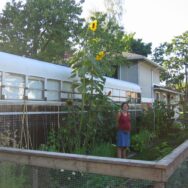
When we moved out of the bus and into a house in July 2008, I found myself often pondering the difference between home and shelter. At the heart of it, our walls and roofs are there to shelter us from the elements, and I suppose, from danger (animals, strangers, thieves, and so on). For most of us I’d wager that they are far more than that. My thought when I first made the transition from bus to house was that our modern world has taken this concept of shelter much farther than is perhaps necessary. In our duplex, I was so completely sheltered that I no longer had a daily, intimate connection with the outside world, including the weather and the neighbours. The living space was at the rear of the house and the side facing the street (and our neighbours) was dominated by our garage. Other than when we chanced to see someone as we came or went from our front door, we had no interactions with our neighbours. We also felt completely cut-off from the natural world, behind our double-pane windows and cozy with our electric baseboard heaters. In the bus, our lives were intertwined with the weather. We could hear the rain dripping, tapping, drumming, slamming on the metal roof (only a few feet above our heads as we slept). We had a woodstove to stoke and a propane furnace to feed (40Lbs of propane—two BBQ tanks—every 4 days in the winter). We monitored our propane usage to try to avoid the dreaded scenario where we would run out in the middle of the night, which meant waking to see our breath in the morning and no chance for hot tea (propane stove) or a hot face cloth (propane water heater). Without leaving our home, we could tell when the temperature dipped or climbed outside. We could tell if it was stormy by the sound of the rain on the roof and the rocking of the wind. In the winter, we had to wrap our water lines with insulation and cover our 26 windows with plastic. In the summer, every window and both doors would be wide open to circulate air as the temperature in our metal box home climbed to the 40’s. Those rows of single pane windows also put us in touch with our neighbourhood. We learned quickly the value of curtains, living on the corner where a city bike route intersected with one of the most well-used East Vancouver parks. Being an unusual sight in the city and being in a high traffic location put us in touch with our community: the dog-walkers, the families, the bicycle commuters, the Farmer’s marketers. We certainly didn’t blend in, try as we might. We felt as if we were an integral part of a vibrant community. We heard stories of people in other parts of the city talking about the bus at Trout Lake. Our community included strangers who would only nod as they walked by, it included the regular passers-by that we would recognize around the city or on The Drive, it included the neighbour who babysat for us, the neighbour who brought back gifts from Bali, the neighbour with a hat collection. We lived in our duplex for a year and never really got to know anyone in our community. Our street was a cul-de-sac but there were no street hockey games, no block parties. Often when we got in the van to go somewhere, nothing would be moving, no life would be visible. The duplexes around the cul-de-sac were all the same. We disappeared. Our neighbours disappeared. Once inside, we were sheltered, cut-off. No chance to create or feel a community. Our time living in that duplex felt like a year of sensory deprivation. Our duplex never did feel like a home because homes are not meant to shelter us from community. Our four walls don’t just ward off danger; the keep family together. They embrace us. They connect us. In most parts of the world, homes are not built in isolation, but...
Read MoreWhy We Do It

The Tiny House Listings blog recently asked Why Do People Fall in Love With Tiny Houses? I have a lot of thoughts on this ranging from financial freedom to humans are wired to like cute, diminutive things. Tonight, I would like to explore the question a bit and give some of our history at the same time. I’m sure for most people who meet us or stumble across our story, there is a big silent (or not so silent) “WHY?!?” hovering in the air. On more than one occasion, there has also been some question as to whether or not we are doing this because we are poor, as one lovely 8 year old put it. Why do we live in a converted school bus? Is it because we are poor? No, we’re not living in a bus out of financial necessity per se. It wasn’t a case of losing our home and having to move our family into a bus or be homeless. In fact, our previous rental was $1200/month and we were managing that. And yes. We are too poor to buy into the housing market where we live. One of the “mistakes” we made was not getting into the market earlier with a starter home (a condo or an 800 sq ft 1 bedroom bungalow). Now, with three kids and a business with multiple business vehicles, our needs in a home have put us in position where all the suitable homes are far above our income level. Furthermore, with the rental market the way it is, we don’t have much opportunity to save a down payment while we’re busy paying the mortgage on someone else’s investment property. We also can’t afford to buy property and build our own home. Property values in our area are inflated by out-of-province and off-shore interests to the place where raw land is almost as expensive as buying a home in town leaving no extra funds for bringing in services and building a home, and the required down payment on land without a house further prices us out of the market. Still, in a lot of ways, we don’t see any of this as a mistake, but rather a choice as I’ve discussed before in my post Just Renting. We have consistently made decisions to prioritize our family, rather than the financial success–whatever that means–of owning a home. Why have we chosen to live in a converted bus? For Fun!! Yes, our initial motivation was because it seemed like a fun project. We were caught up in our new relationship (read: we were suffering from the impulsiveness of those newly in love). We were excited by the idea of doing the project together (as opposed to buying an RV). I personally (I don’t speak for Aaron here) was in a place of needing to do something different and shake up my life a bit as I was stuck in a rut. Aaron had lived in a van for a couple of years while treeplanting and had seen some bus conversions. My parents had talked about bus conversions when I was growing up in the 70’s and 80’s. Aaron’s neighbour was a journalist who had recently interviewed some folks who lived in and around Vancouver (off-the-grid) in converted vehicles of all kinds (milk trucks, buses, etc.) and we were inspired and intrigued by what they called the Urban Technomad movement. This was before I had ever heard of the Tiny House movement and I can honestly say that our initial motivations didn’t have much to do with saving money or living lightly on the earth. Thankfully, all these years later, despite the inconveniences, we still do it because it’s fun! Finances. While the conversion itself cost more than we would like to admit (to the point where we actually stopped keeping track), we did appreciate the financial benefits that came with paying less rent. In the five years we lived in the bus in Vancouver, we paid off more than $30,000 of joint student loan debt. We could never have done that...
Read MorePleasantly Surprised
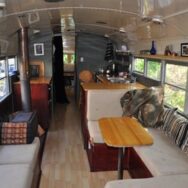
I mentioned last week that in the months preceding this move, I was a tad anxious. The night we signed our lease, I laid in our King size bed and wondered, “What have we done?!?!” Then in May, as we were gearing up to move and our little cabin addition (with laundry and bathroom) was still far from finished, I developed stress-induced eczema on my foot. At some points, it was so painful that I could barely walk. I was functioning: packing, feeding the kids, doing everything that needed to be done, and wasn’t really feeling super stressed, but obviously the question of how we were going to make this work was weighing heavily on my mind. Our move went relatively smoothly as far as moves go, but it was still a move with three kids in tow. It was hard and exhausting and followed by a really unfortunate dispute with our former landlord. The cooling unit in our bus fridge fried itself and the company shipping the gigantic replacement part made a mistake and didn’t ship it which meant that for the first two weeks after our move, we had no fridge. Our summer started off cold and rainy so despite being the end of June, we were still having to heat the bus with the woodstove. To top it all off, we had no way to do laundry and we were generating at least a load a day. I tried hauling all three kids to the laundromat twice before I vowed to find a different solution. Sounds like a recipe for unhappiness, doesn’t it? But it wasn’t. As soon as we got all the boxes unpacked, everything was ok. I was amazed. It felt…well, it felt good to be home. I couldn’t believe it. I was pleasantly surprised to find that: The kids took the move in stride. They were so happy to be running around on the farm, exploring and checking out the animals. Noa was heard several times a week sighing wistfully and saying “Isn’t it wonderful?” There was far less mess to deal with. It only takes minutes to clean up a 300 sq ft space and the kids seemed to like knowing that everything had it’s own place. They were really good about putting away one toy/activity before taking out anything new. I spent far less time picking up after them than I had at our previous houses. The kids argued less about tidying up. In fact, they hardly argue about it at all anymore. We were in the bus for 10 whole days the first time either of the big kids complained about having to pick up their things. In our old houses, these arguments were daily occurrences. Now, they just seem to get it that there isn’t any space to play lego if their puzzle is still laying out. I didn’t mind doing dishes. I’m not a big fan of doing dishes and I was really lamenting the loss of our dishwasher, but I found that washing up after every meal provided a nice rhythm to the day and it was intensely satisfying to see our tiny lovely kitchen all clean and sparkling after only 15 minutes of work. More importantly, because I was spending less time arguing with and picking up after the kids, I actually had the time and energy to do the dishes. Silas’s sleep even started to improve after we moved (we’re still a long way off though). Even when the bus is an utter disaster, it takes only a matter of minutes to clean up. A friend was coming for tea at 9am, which is a little early for me to get functioning. Nevertheless, I had all the beds made, dishes done, counters wiped, floors swept, kids fed and dressed, all before my friend arrived. Anyone looking at our ramshackle, construction zone, make do, cramped bus from the outside might not understand this: somehow – despite the unfinished cabin; despite everything we’re juggling at the moment; despite the inconveniences of laundry, bathing, and sleeping arrangements; despite...
Read More

Recent Comments
No comments to display