


Featured
The Question of Three

“What’s it like, having three kids?” “How’s it going with three?” “How are you doing? With three kids, I mean.” That’s what everyone wants to know. The question is usually asked with a mixture of genuine curiosity, horror and pity. It’s like they are staring at a picture of a train wreck and asking a survivor how they managed to get out alive. They want to hear all about it but they can’t help but betray the better-you-than-me attitude. Our concerned friends—the ones who really care about us—seriously want to know how we’re managing because God, three kids (!), how does one manage? They want to know if we’re ok because well, they are scared for worried about us. They are checking in to see if everything is going well, or if we need help, but there is always that hint of a suggestion that three kids is just too much for two parents to handle these days. We also get this question from strangers and acquaintances: parents who kinda sorta wanted to have three but weren’t brave enough (or managed to get the vasectomy before there was an accident), parents who find one or two kids completely overwhelming and who think we are totally nuts, or people who secretly think we’re being greedy. These queries are actually in the hopes that we’ll tell them it really is as bad as they imagine, thereby affirming their own parenting decisions. Coincidentally, we asked this very question a lot after we found ourselves unexpectedly expecting a third. Every time we ran into someone with three kids or even heard of someone with three kids, we would ask this question without even attempting to hide our hopes. Our question was really more of a pleading to please, please, tell us it isn’t as hard as we fear it will be. Tell us that by the third time around, the kid just slots right into the family and no one even notices that it wasn’t there before. Raising young kids is hard physical work. It’s tiring and often kind of drudgerous. Discipline issues can be frustrating and mentally taxing. It really isn’t easy and with three kids, we’re outnumbered. Two parents, two hands. I can physically only hold onto two kids at a time. If they all run different directions, two parents can really only chase down two of them at any one time. It takes a different set of skills to manage three than it took to manage one. Fair enough. I totally get why people ask, why I asked and why I feared (heck, why I sometimes still fear) being a mom to three kids. But I do find it interesting that the idea of three children is so universally considered to be such a terrifying burden. It seems to be the absolute limit to how many children people can even try to imagine having. I bet you anything that by the time someone announces their 4th or 5th child people don’t even ask anymore. They just smile and nod. What do you think? Have you asked this or been asked...
Read MoreNavigating Sleep with a Third Child

{This is a follow-up to my January post Reconsidering Co-sleeping where at 35 weeks pregnant I revealed that after 2 kids and 5.5 years of co-sleeping I was considering a crib for my third child.} I had this idea back in January that I wanted to write a post that would realistically present the nuances of co-sleeping, that would argue that Attachment Parenting is not a set of cult rules but rather a complex personal philosophy that shifts from family to family, from child to child, and over time. By highlighting my own sleep struggles and divided mind on the issue of co-sleeping, I wanted to show that you can still be an attachment parent even while you decide not to embrace all elements of the philosophy…because you are making the best decisions for your family in the spirit of striving for balance in personal and family life. I believed that my post was balanced in that I could be honest about my struggles while remaining incredibly supportive of co-sleeping (from personal experience not just a theoretical standpoint). Some commenters correctly pointed out that there is a difference between co-sleeping and bed-sharing. Dr. William Sears, a well-known pediatrician and author of many parenting books, defines co-sleeping as sleeping within arm’s reach of the baby. Bed-sharing on the other hand is actually sleeping on the same surface, in the same bed, as the child. Having slept with both of my kids since 2005, I know that distinction, and yet, for some reason, I seem to continually use the two terms interchangeably. To be honest, I find that many people do this on a regular basis and while I find the distinction can be important, I also feel comfortable with my use of co-sleeping to encompass all the ways that parents share sleep with their children. I really enjoyed all the commenters who shared their personal stories, experience and tips. I appreciated the tips and atmosphere of support though as a long-time co-sleeper and supporter of the practice, most of the ideas were ones that I had entertained and discarded as not working for us in our 800 square foot, 2 bedroom house. No chance of a mattress beside our King size bed that took up our whole room. No chance of a double bed in the kids room that already housed a loft bed, toddler bed and all of their clothes and toys. Nevertheless, I really appreciated the helpfulness and understanding. However, there were also comments (notably in response to a re-posting on the Natural Parents Network facebook page) along the lines of “every child deserves to be co-slept with” and “I co-slept with all 4 of my children and wouldn’t have it any other way.” I regretted that I had somehow given the impression that: I was planning to stick the baby from Day 1 in a crib in a room down the hall, I had no intention of being sensitive and responsive to the individual needs of this particular baby, I was absolutely, certainly never going to sleep with this baby at all, I no longer supported co-sleeping, My mind was made up. My intention from the day of that post was to start with a bassinet beside the bed and move after a couple of months to a crib in our room, a few feet away from our bed. This way I could still hear the baby easily and respond before baby cried but I would have a little more physical space so that I would not jump to attention every time baby stirred and so that baby wouldn’t get in the habit of nursing every hour. As a mother of two other children, I was also well aware that even our best intentions are at the mercy of our individual babies. I was prepared for the fact that this baby might not want to sleep anywhere other than on my body. As an ardent supporter of co-sleeping for its benefits, I was also prepared to share my bed with the baby whenever necessary, if we were...
Read MoreOn Being a Bad Blogger

Some bloggers post every day or at least a couple of times a week. I’m not one of them. In case you hadn’t noticed the time lag, I just posted my son’s birth announcement SEVEN weeks after he was born. Initially my intention was to post about 5 times per month but eventually I just gave up on that and decided to be a bad blogger. Why be bad? Well, being a good blogger takes considerable effort. You have to post regularly, and hopefully that means often, but at the very least it should be regular. It takes time to write posts, especially when you’re just starting out and not really well practiced at coming up with ideas or writing short posts (I’m raising my hand here). In addition to the time spent writing, you might have to research your posts which takes longer. You have to read and respond to comments if you get them. You need to create community by reading and commenting on other blogs. And you have to drive traffic to your blog through social media. This is what it takes to be a good blogger. Recently Melody from Breasfeeding Moms Unite decided to call it quits because she was no longer willing to be a good blogger. It was taking her away from her children for too many hours during the day and it was impacting her ability to be the mom she wanted to be, especially regarding screen time for her children and herself. I really admired her open and honest post when she hung up her hat. I too am not willing to be a good blogger. I just can’t do it. I don’t have the time. I am homeschooling my son, I have a toddler and I just had a baby. I am not willing to have the kids watch tv all day and I can’t stay up at night to blog because sleep is already at a premium around here. But I don’t want to quit either. I want to write. It’s good for my adult brain to practice writing and I want to get better at it. It is something that is just mine in this life stage where I have so little me left at the end of the day. Unlike a journal however, blogging gives my writing context. Having some preset ideas of topics helps generate ideas. I also follow people on twitter and facebook that write on similar topics so I often find interesting things to read and also informs my writing. The format also gives me a reason to edit, spellcheck, refine my craft and add pictures. This doesn’t happen when scribbling in a notebook. And let’s not forget about the audience. Nobody reads your journal and you have to be highly skilled, polished and ambitious to be published in print. Blogging means that my writing can be part of a dialogue with other people rather than just something I do by myself. I love getting comments and subscribers. I love when other bloggers touch on similar topics. I love being inspired by other bloggers, by articles and studies I find through twitter or facebook. The audience makes me feel like I’m a part of something. For me, that is a specific something. When I sold my birth supply business, I felt a big hole in no longer being active in the birth advocacy community and I wanted to stay involved somehow. My focus has grown since that time and because this blog has a general focus that my business site didn’t have, I feel connected to the broader parenting community. I may not blog every day (or every week) and I may not have thousands of readers. I may not actually get the chance to write every post that rattles around in my head while I load the dishwasher and change diapers and play Uno. I don’t read all of the posts in my blog reader (mark all as read anyone?) but I do make an effort to comment on the ones I do...
Read MoreAnnouncing…

…{better late than never}… Silas Blaze February 16, 2011 ~ 1:48 am 8 Lbs 5 oz. 19.5 inches Birth story to follow.
Read MoreGratitude: the last word on my last pregnancy

For many years now, I have taken the last week of December and first week of January to reflect on the closing year and anticipate the coming new year. Last year, I even chose a word of the year. I had every intention of doing that again this year but alas, in my advanced stage of gestation, I found that I could not think beyond the task set for me for mid-February: birth. Between Christmas and Valentine’s Day, all I could focus on was preparing for the new baby. My blog was quiet. My life was full. And tiring. So, this year there was no word of the year. But there was a word. The word that continued to bubble up in my mind every week was gratitude. For my pregnancy. For my baby. For the fact that it was my last foray into childbearing. I was grateful for: pregnancy perks: my strong fingernails my shiny & manageable hair gaining weight (I’ve struggled with being underweight since high school) bigger boobs friends and strangers who revelled with me in the anticipation of waiting for a baby to arrive (being pregnant in the winter with bulky coats and sweaters over my belly meant that even at 9 months few people noticed that I was pregnant so I didn’t have a lot of people asking about my pregnancy). the wonder and magic of pregnancy – feeling baby’s kicks and rolls Rain’s utter delight in my pregnancy and growing belly and his excitement as the birth drew near a complication free pregnancy an informed pregnancy (knowing that I could decline diabetes screening and other tests, knowing that I could dialogue with my midwives about our hopes and expectations for the birth, knowing my body and intuitively understanding the process I was going through because I had experienced it twice before) access to midwifery care access to modern medicine like the routine 20 week ultrasound that re-affirmed that our baby was healthy, hospitals & specialists should we need them, and an ever-growing body of research about pregnancy and childbirth a healthy baby an amazing birth team and excellent prenatal care my beautiful pregnant belly Lest you think I am one of those annoying people who have perfect pregnancies with no discomforts, I did have my fair share of complaints. There was the debilitating all-day nausea that plagued me for the first 20+ weeks. There was the nasal congestion that started the first day and just got worse and worse until I was sleeping propped up on 3 pillows, spraying saline up my nose daily and wearing the oh-so-fashionable Breathe Right strips nightly (have you seen what those cost?!?). There was the middle of the night acid reflux – waking up because you have vomit at the back of your throat is not very fun, but it did give another reason for sleeping on 3 pillows. I also have to mention the restless leg syndrome, swollen cankles, bleeding gums, and unmentionables like hemorrhoids. But the worst? The worst was the awful SPD (symphysis pubis dysfunction) in the third trimester. SPD is caused by the hormone relaxin which softens the ligaments and causes the pelvis bones to begin widening and separating in preparation for birth. The last 10 or so weeks of my pregnancy I could barely walk as I suffered from sharp shooting and grinding pains in my pubic bone and SI joints. Rolling over in bed, getting up from the couch or out of bed (every 1.5 hours for a trip to the bathroom to pee) was agony. The muscles supporting my belly and the weight of my growing baby felt permanently strained. Essentially, I was in almost constant pain for the last trimester. Yet, I was even grateful for all of the pain and discomfort because it gave me the peace needed to accept that this is my last pregnancy. It confirmed for me that I am totally fine (ok, maybe 90% fine) with never being pregnant again. It reminded me that I am getting older and pregnancy isn’t as easy as...
Read MoreReconsidering Co-sleeping
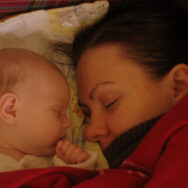
As we wait for this baby to arrive, I find myself seriously considering a crib. This may not seem very inflammatory. After all, for the vast majority a crib isn’t even a consideration; it’s a necessary purchase that requires no thought beyond what sheets to choose. However, we co-slept (or bed-shared) with our two older children. A crib feels like venturing into strange territory. In fact, it even feels like a bit of a betrayal. Not that I have a problem with OTHER people using cribs at all. It’s just for me, it feels like denying this baby some of the wonderful things we were able to give our older kids. Furthermore, it goes against my personal instincts and parenting philosophies about keeping our kids close. In a lot of ways I love co-sleeping. I love the extra snuggles in the night. I love the extra hours of closeness with my children. I love being able to hear, see and feel that they are safe. I love waking up together. I love the early morning cuddles and giggles. I love that co-sleeping makes it easier for Aaron to be involved in night-time parenting. I love looking over and seeing one of my children cradled in Aaron’s arms. There are more practical benefits to co-sleeping beyond all that lovey-dovey stuff though. Many people, including Dr. James McKenna from University of Notre Dame, claim benefits to co-sleeping like the ease of maintaining the breastfeeding relationship and the increased sleep for mom. Long-term effects also suggested include higher self-esteem in adults who co-slept as children and a new book by Margot Sunderland, director of education at the Centre for Child Mental Health in London, “says the practice makes children more likely to grow up as calm, healthy adults.” There are even studies that say that practiced safely, co-sleeping decreases the incidence of SIDS. In my own experience, I saw first hand the ways that co-sleeping made breastfeeding easier. I could just roll over and nurse a baby while half asleep, without having to get up, walk down the hall, nurse in a chair and then carefully try to get baby back in the crib (without rousing her and having to start over). We learned quite quickly to disturb our babies as little as possible in the night if we wanted to maximize our sleep. A baby that falls asleep nursing in a side-lying position is much easier to keep asleep than one who needs to be moved and placed back into a crib. Plus, because I wasn’t getting up, walking around and turning on lights, it was easier for me to go back to sleep after a feed too. The problem is I’m beginning to feel that some of those gains in the early days set me up for some challenges later on. Some examples: 1. Eventually I began to dread climbing into bed at night. I would be tired (from a long day with a toddler who usually went to bed at the same time as us) and ready to sleep but as soon as I jostled the bed or baby smelled me beside her, it would be mean another feed before I could go to sleep. Whether it was 8:30, or 9:00, or 10:00, or midnight. I could not get into bed and just go to sleep. Even if baby had only nursed an hour ago, I was in for another feed before I could punch out. 2. Increased Night Wakings. Both of my kids spent their early days in a little bassinet type bed beside our bed and only moved into our bed when they outgrew their first bed, around 4 or 5 months old. Around this time, we noticed that they were developing skills for soothing themselves back to sleep. We would hear them rustle, re-settle, perhaps suck a finger or thumb and then go back to sleep. Around this time, hours of consecutive sleep were increasing from 2 (with a newborn) to 4 or 5. By the time both children were a year old, they were waking...
Read More

Recent Comments
No comments to display