

Featured
Just Nursing

Welcome to the July 2010 Carnival of Nursing in Public This post was written for inclusion in the NursingFreedom.org. All week, July 5-9, we will be featuring articles and posts about nursing in public (“NIP”). See the bottom of this post for more information. *** I don’t consider myself a lactavist. I didn’t call the CBC when I was asked to move into a change room at Superstore while nursing my daughter. I have not been to a nurse-in. I have never smuggled breastmilk onto a plane. I do think that breastfeeding is a normal natural beautiful act. I breastfeed my daughter anywhere I choose. I don’t let people’s opinions or rude looks stop me. I will breastfeed in a restaurant. At my table. Without a cover. I exclusively breastfed both of my children to 6 months. I continued with my son until he was 2.5 years old and probably will with my daughter as well. I breastfeed because it’s part of the package deal of pregnancy, childbirth and breastfeeding and for me, it never became a choice. I was lucky in that both of my children latched well and I had an abundant supply. We took to breastfeeding with relative ease. Sure there was some soreness and some leakage and some fumbling with breastpads and straps and gaping wide rooting fussing baby mouths, but overall, it was pretty easy for us. I was lucky in a couple of other ways too. I had good role models: women in my family who went before me and treated breastfeeding like the most normal part of life. Women who paved the way for me to feel just a bit less self-conscious during all of that fumbling in the early days. I had supportive extended family members who didn’t bat an eyelash when I fed the baby in front of them, in-laws who never say anything unless it is a kind word. So for me nursing was just nursing. I never had to make a distinction between nursing and nursing in public. It was all the same. I didn’t have to go into a different room because my father-in-law was visiting. I didn’t feel like I had to cover up because I was at a restaurant. I didn’t have to go out to my car because my baby got hungry in a store. Sure there are nuances when I’m in public, like wearing a bra or sometimes having a hard time finding a comfy seat, but overall, I treated the act of feeding my baby the same no matter where I was. I got good at nursing while walking around a store (though I never figured out how to nurse in the sling) or even just sitting on the ground or leaning against a wall if I couldn’t find a seat. And I fed my baby. I am also lucky to be a very internal, introverted person. I tend to get lost in my thoughts a lot when I’m out and about. I can be kind of oblivious to those around me. My husband is always noticing the people who pass by while I am busy noticing the sky, the flowers or zoning out to my internal to do list and inner monologue. Surprisingly, this is a nursing in public superpower. This means that I can honestly say that I’ve almost never noticed a person glancing askance as I lifted my shirt to latch my hungry baby in the grocery store or a park or the library. I feel kind of oblivious and sometimes this is a bad thing but when it comes to nursing in public, it’s the equivalent of a very thick skin. My experience, breastfeeding my babies in Canada, was almost entirely positive, but I know that isn’t the case for the majority of women in North America. I know that too many women feel unsupported and self-conscious. I know too many women feel frowned upon for attempting to feed their babies in public. I feel terribly sad that we even have to make a distinction about nursing in...
Read MoreThe Breastfeeding Choice
Lately, it seems that everyone is debating the choice to breastfeed. Reading various blog posts and opinion pieces, got me thinking about why I breastfed my two children. Health campaigns having been making it clear that there are major health benefits including lower rates of asthma and diabetes in children and lower rates of breast cancer in mothers. The oft-cited lifestyle benefits include convenience (always having baby’s food with me no matter where we are, never having to heat bottles, never running out, not having to bring a lot of extra gear on outtings – besides a couple of diapers), cost-savings (not having to buy bottles or formula), better sleep, ability to soothe a baby who is hurt, getting a vaccination or whose ears are bothered by the pressure on an airplane. These are all great reasons to decide to breastfeed, but for me, they were like bonuses, icing on the cake. They weren’t the reason I breastfed my children. To be honest, I didn’t consider breastfeeding a choice. I suppose I could say that I thought it was my responsibility in a way but even that doesn’t really describe my feelings. I didn’t do it out of a sense of duty. I did it because that is what is involved in my role as a mother. For me, breastfeeding was just part of the package of childbearing. Just as I didn’t really have a choice about how to conceive, just as I didn’t really have a choice about growing and carrying a baby inside my body, just as I didn’t really have a choice about when and how I would push that baby out of my body, I didn’t feel I had a choice about how I feed that baby. Sure, in this day and age, we have things like IVF for conception, surrogates for pregnancy, cesareans for birth and formula for feeding. But in my mind, those wonders of science are available to make childbearing possible in spite of insurmountable challenges. For me, they are not choices. For me, the choice I had was whether or not I wanted to have children at all. Once I made the decision to have children, I embarked on a path that included pregnancy, birth and breastfeeding because that is what is involved in having children. Along the way, I had choices regarding my prenatal care, my place of birth and the length of time I breastfed my children, but I didn’t really have a choice about the steps in human procreation. Of course, all those steps involve some pretty big downsides like cankles and heartburn, contractions and the Ring of Fire, thrush and mastitis. But all three are also the most amazing privileges. We get to feel the wonder of the baby moving and growing inside of us, we get to experience the transformative power of childbirth, and we get to nourish and bond with our babies in a very primal physical way. Nothing about parenting is easy. Some of us will experience challenges with almost every aspect, from the moment we start trying to conceive. But we do it anyway because that’s what it takes to parent. We do what our children need us to do because it’s just a part of the deal. I guess one of the major differences is that all things considered our culture is supportive of pregnancy and birth (barring for now major ideological differences regarding what childbirth should look like). But breastfeeding is another story. Our culture does not support breastfeeding. The average North American woman is not living in an environment that makes breastfeeding something that feels normal, or even possible. The average woman is not supported by extended family to breastfeed. The average woman receives conflicting and erroneous advice about breastfeeding from the hospital, her friends and her health care providers. The average woman feels that breastfeeding in public is offensive or imprudent. The average woman is sent messages every day from society, from the media that tell her that breastfeeding is either creepy or too intimate to occur outside of...
Read MoreThe New Home School
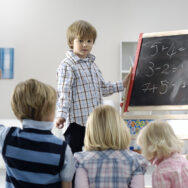
This is Part IX of the series Kindergarten Considerations in which I have been discussing (and wrestling with) the considerations behind the seemingly innocuous decision of where to send my four year old son to school in the fall. Some of our top options have included Montessori education and Waldorf Education. Today we are talking about homeschooling. Homeschooling certainly isn’t what it used to be. As I child of 11 or so, I knew one girl who was homeschooled. It was for religious reasons and it seemed strange to me. I think we often envision homeschoolers as shunning society in general, studying by light of an oil lamp in a cabin far from any possibility of the negative aspect of socialization. When people mention homeschooling, one of the first responses is often related to the child’s need to play with peers. That and “I couldn’t do it – my kids drive me crazy!” Let’s begin by saying that homeschool has evolved far beyond that stereotype. For one thing, mainstream culture seems much more accepting of homeschooling, perhaps not as an option for themselves but at least as an option for those who choose it. The Canadian magazine Today’s Parent actually had a feature article on homeschooling in their May 2010 issue. Secondly, it’s much more widespread than it used to be. The article above puts the number of Canadian homeschoolers at 80,000 and at 2 million in the US. Perhaps this is why the average person no longer regards homeschooling families as freaks – many people know at least one family who is homeschooling and realises that they have legitimate reasons for doing so and also, that their kids are thriving. Beyond that, what does homeschooling look like these days? In BC, provided you follow some kind of educational plan, you can school your child at home in any way you choose. That might mean registering at the local school but teaching at home and having access to resources at the school (if your local school is open to working this way). As the Today’s Parent article points out, there is financial incentive for schools to work together with homeschooling families because the government provides funds to the school to cover homeschool students registered there. Alternatively, you could register your child in a distance education program where the child will follow a specific curriculum but complete it at home. In the past this was done via correspondence with workbooks and texts received through the mail. Technology has revitalized this system but it remains essentially the same. However, there are increased opportunities for interacting with virtual classmates and teachers with the advent of chat rooms, message boards and Skype. There are multiple programs that fall into this category of learning including those that follow very closely the public school curriculum and those that use unit based learning for instance which might involve learning science, math, English and history all through the lens of a particular theme. These programs may also be religion based if that is important to you. In these programs you are responsible to follow the curriculum as set out by the program you have registered with which includes meeting deadlines, completing tests and reports (if there are any) on time etc. You can also register your child as an independent learner and then you can choose how you want to teach. On this side of things, you then have the option of registering in a program that supports independent learning or going it completely on your own. From what I understand, if you choose the latter option, you are then responsible to report to the ministry about your educational goals and progress. The sheer number of possibilities can actually be very overwhelming. Luckily, homeschooling was demystified for me 7 years ago when we began living with my sister the first year she started homeschooling her 4 children. I’ve had a chance to see up close how it works and I have an excellent person to ask for help and advice. Nevertheless, I should also say that one...
Read MoreOutdoor Education
Living in the Pacific Northwest means that the winter is dark, gray, rainy, and wet. As you can imagine, we have rubber boots and rain gear so that we can still get outside in the middle of winter, but I will be honest with you: we really don’t do it a lot. Come summer though, we practically live outside. The days are long and bright. The weather is warm, not hot enough for my liking, but we make up for that with the lack of bugs. There are plenty of opportunities for fun in our backyard and around our lovely corner of the world. There are so many amazing things about outdoor play: the opportunity to blend play with exercise and fresh air, the ability to create unique and imaginative play spaces with fewer restrictions than you might have indoors, the possibilities for open-ended play because there are fewer toys outdoors. One of my favourite things about outdoor play is the way that being in nature inspires learning. From the time he could walk, Rain loved bugs. This is probably where his outdoor education began as we started turning over rocks in the back yard to find pill bugs, snails, banana slugs, ants, ladybugs and spiders. He learned their names and where they were most likely to be found. He has an observation jar (clean peanut butter jar with holes in the lid and the labels removed) where he keeps the specimens he catches so he can watch them. We do enforce one observation jar rule that all critters be released at bedtime each day so they don’t starve or miss their mothers too much. From there he started learning plant identification. Daddy is an arborist so we tend to notice and talk about trees quite a bit. By the time Rain was two and a half, he knew how to spot a weeping willow, a mountain ash (rowan tree) and a Japanese maple. Some great books to incorporate when learning about trees and shrubs are the Flower Fairies series by Cicely Mary Barker. We have the Flower Fairies of the Autumn book which has lovely illustrations and poems for Oak tree, Rowan tree, Dogwood, Blackberry, Rosehips and more. He would point and call out the names of trees he noticed when we drove around town. There are many tree related learning activities you can use to continue the conversation after you move indoors or as you explore the forest. You can: Talk about the shapes of leaves. Gather a whole bunch of different ones and paint them and use them to make prints on paper. Discuss the difference between conifers and deciduous. A fun story to listen to at the same time is The Evergreens by Odds Bodkin (find it at your local library on CD). Compare the size of a seed to the size of a mature tree. Talk about the different types of tree seeds/flowers there are: samaras, catkins, cones, acorns or other nuts like horse chestnuts etc. (Oh and by the way, they aren’t called pine cones if they’ve fallen from a hemlock or a cedar tree. My husband has pointed this out to me more times than I care to admit.) You can also compare the size of cones from different evergreen trees. Identify the shapes of different trees. Are they triangular, oval shaped, bell shaped, globe shaped? Talk about the life cycle of plants over the seasons – this is particularly obvious for trees in fall and spring of course. When Rain was 3.5 years old we moved to a new house where we had a yard that was big enough to plant a veggie garden. This created many new opportunities for outdoor learning as he helped us plant seeds. He learned that they need warmth and water to grow, that when they first sprout there are usually only two leaves and that sometimes the sprout is still wearing the seed case like a hat. (A great book that talks about seeds in called A Seed is Sleepy). He learned about transplanting bedding...
Read MoreBriefly May

What I learned in May 2010: If either of my children intends to pursue dance in the long term I have to be prepared for a ridiculous schedule of rehearsals at recital time. Rain has to be at dance 11 times over the course of two weeks, which involves hauling a squirming toddler inside and trying to corral her while wrestling Rain into dance shoes and ushering him into class in a sea of parents and preschoolers in a room the size of a closet. Run I mean, fun! Making butter from raw cream straight from the farm is not as straightforward as using store bought whipping cream, but tasty nonetheless and Rain loves kneading bread. I love working at the midwifery clinic as office administrator and when I put my mind to it, I CAN write a bio. I love Sir Ken Robinson, love his TED talks and I am currently loving his new book, The Element. I would sew a lot more if I could leave my sewing machine set up permanently. I can get a lot of sewing done while my daughter naps and having all the pieces cut and ready to go ahead of time makes sewing much more enjoyable. The weather in May is much more unpredictable than I would have predicted. Hello summer? Where are you? The steps to being awesome are easy to come up with but following them is not. Burt’s Bees avocado butter pre-shampoo hair treatment makes my hair happy. Rain is a comedian, an artist and has a flair for showmanship: Rain came out of the bathroom calling “Mom, you have to come see the treat I made you!!” I replied, “Promise me it’s not poop.” He said, “I promise.” As I entered the bathroom, he pulled a towel off the towel bar with much fanfare to reveal his masterpiece: a drawing of himself picking his nose! I can assure you that I was NOT able to keep a straight face as I explained that we do not write on the walls of our rental...
Read MoreAre YOU awesome?
I’ve lost track of the numbers of people I’ve met who have no real sense of what their individual talents and passions are. ~ Sir Ken Robinson Earlier this month, I lamented my inability to write a bio. Being between projects makes it difficult, but so does being the mom of young children. With all our focus on the needs of other people in the household we may find that we don’t know ourselves very well anymore. The time away from work also messes with our identity a little, especially if we begin to reassess our goals, dreams and values in light of our new roles as parents. The longer we are away from the workplace, the more we begin to notice that our society tends to define people by what we do and what we are good at. And if you spend the majority of your time conversing with preschoolers and wiping noses and bums, it’s easy to lose your grip on what your other talents may be. But perhaps the problem runs deeper. Perhaps it wasn’t just born out of motherhood? I have a sneaking suspicion that even before I had children, I was easily counted in the numbers of people who have no real sense of what their individual talents are. This got me wondering why so many of us don’t know what makes us awesome. Why is it so hard for us to answer these questions: What makes me awesome? What makes me feel awesome? What are my awesome skills? Do you know who you are? One of the reasons is that some of us might not know ourselves very well to begin with. As young people, we can take for granted who we are. In our teen years, we may be trying on personas but it comes closer to experimentation that to genuine self-knowledge. Twenty-somethings can get caught up accomplishing things: checking off relationships, marriage, house-buying, career-building, and having children on that inner to-do list. We might never really take a moment to think deeper about who we are or why we are awesome long enough to actually believe we are awesome. It’s not such a surprise then that this issue still dogs us post-motherhood. Perhaps we’re just more aware that it IS an issue once we have children? Perhaps it’s the first time we’re old enough to think about it seriously? Furthermore, how many of us really make a point of nourishing our relationship with ourselves? Of being our own best friend? If we treated our friends the way we treat ourselves – only hanging out once every six months – it wouldn’t be long before our friends would stop talking to us too. Dr. Daniel Siegel talks about the ways in which meditation and mindfulness activate the same parts of our brains as do attached interpersonal relationships and he goes on to say that these practices are very like becoming our own best friend. Perhaps spending time getting to know ourselves is the first step to discovering our innate awesomeness? But even then, we may still struggle with self-appraisal, with figuring out what makes us unique. Have you found your thing? In his new book The Element, Sir Ken Robinson explains that successful people find themselves in their element. The element is the intersection between what you are good at (your talents) and what you love (your passion). Some of us are good at things that we don’t really enjoy but true success is found when we discover our element. Furthermore, the element also requires that you have the right attitude (a willingness to go for it) and the opportunity. This part seemed really key to me. Your element could very well be surfing but if you live in the desert, you may never find that out. You need both the opportunity and willingness to try surfing if you are ever to discover that it’s your awesome thing. So, by now, maybe you believe that you are awesome at something but you haven’t yet figured out what that thing is. Want to...
Read More

Recent Comments
No comments to display