

Parenting
Attachment Village

At the end of February I had the pleasure (and good fortune) of being able to attend a full-day lecture by Dr. Gabor Mate. You may have heard him on CBC discussing his work as a doctor in the Downtown Eastside in Vancouver. Or you may have read one of his books including Hold On To Your Kids: Why Parents Need to Matter More Than Peers (which he co-authored with Gordon Neufeld), Scattered Minds: A New Look at the Origins and Healing of Attention Deficit Disorder, When the Body Says No: The Cost of Hidden Stress, or In The Realm of Hungry Ghosts: Close Encounters With Addiction. His work is incredibly fascinating and after 8 hours on a Saturday spent listening to him talk, my mind was reeling and whirring for several days as I tried to digest everything. A couple of days later, I attended a school function where a fellow parent asked me to sum up the presentation or give the “one nugget” I had taken away. I was struck totally dumb. I couldn’t even begin to succinctly summarize the broad range of ideas that had been touched on. I’m sorry to say that my response was probably not a 30 second sound bite worthy of Dr. Mate. But, 10 days later, I’m ready to give it a try. Essentially, Dr. Mate’s work deals with the mind-body connection. Babies are far more susceptible to stress in their environment than we might suppose. This includes prenatal maternal stress, but also from the circumstances of the birth itself, from separation from the mother, from the family/living environment. Dr. Mate explains that in response to stress, we may use adaptive states or protective behaviours as coping mechanisms and when these adaptive states which are meant to temporarily insulate us from the effects of the stress become long-term traits, we can see a variety of problems arise. These problems can include AD(H)D, autism, cancer, auto-immune diseases, addiction and more. The subject of Dr. Mate’s talk on this occasion was The Biology of Loss: What Happens When Attachments Are Impaired and How to Foster Resilience so he was talking specifically about working with/parenting children. He brought up the dangers of the rising cesarean section rate, and the problems of using methods like cry-it-out to get babies to sleep. He discussed what happens when children become peer-oriented rather than seeking their cues from the adults in their lives. He also explained the optimum conditions for an attachment relationship, and how and why a relationship may be negatively affected. So, what did I take away as the nugget of the day? Firstly, I was struck by the fact that we are all carrying our own issues from childhood into our adult lives, and therefore, into our parenting. Dr. Mate says that in order to form strong attachments, babies need a non-stressed, non-depressed mother. I remember when I first read Hold On To Your Kids I was expecting to gain all this insight into my parenting, and for the first half of the book I found I was learning more about myself, about my own adolescence and early 20’s. All of this serves as further validation of my own parenting theory which is that if you want to be the best parent, you have to work on being the best person you can be, you have to understand yourself, your motivations, your own unhealthy stress responses, your own childhood traumas. The short version: You want to be a good parent? Deal with your own shit. I’m reminded here of a quote from the day which unfortunately I can not remember the source for: The greatest gift we give our children is our happiness. Secondly, I felt rather relieved of the huge burden of mother-guilt I carry with me most days. Listening to Dr. Mate speak, I was acutely aware that as far as healthy attachments go, we are doing a lot of things well. We are privileged enough to be able to make a lot of choices in our lives in our children’s best interest. They...
Read MoreWeaning, Fertility and Moving On
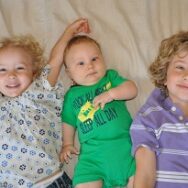
Last week, as I picked up Silas after his nap, I folded my arms around him, nestled my face into his neck to kiss him, and he exhaled the sweet smell of breastmilk. It was a few days before his first birthday and as I breathed in deeply, trying to save the memory of it forever, I knew it would be one of the last times I would smell that sweet odor on his breath. I would be lying if I said that it didn’t make me almost unbearably sad. I nursed my older two children both until they were just a few months shy of three years old. I assume it will be the same with Silas. However, the weaning has already begun. He eats table food and I can go out for four hours without him needing me. The frequency of his nursing will be gradually diminishing over the course of this next year, until I notice that he only nurses when he’s sad or hurt or going down for a nap. And then, another day, I will realize that he hasn’t nursed in a few days and I can’t even remember when the last time was. Newborns seem to always have that milk breath smell about them. But toddlers—and Silas certainly seems to be crossing into toddler territory these days—toddlers have their own smells. Soon enough, the milk breath will be just a memory. It seemed fitting that this moment should have come during the week of his first birthday, as I reflect on his birth, as I try to make peace with the idea of not having a baby anymore, or ever again. With all of this comes the realization that my menses should resume soon. I am still waiting, but I feel my body changing, gearing up as it were. I never was one of those moon-goddess women who celebrated having my period or who saw it as some divine female rite. To be honest, it is painful, uncomfortable, messy and pretty much a pain in the ass… However, as a woman of childbearing age, I can appreciate the idea of being connected to the rhythms of my body, and as a mother, I am grateful that fertility-wise I had little trouble conceiving, that I had knowledge and more or less the control over whether and when we had children. I never did look forward to getting my period back after each of my children were born—though I likely would have felt differently if we had been anxious to conceive again and it was nowhere in sight. Now, at this point in my childbearing path, when I consider that my fertility will be returning soon, I can’t help but feel more than a little put out. It seems pretty pointless for me to continue to endure the downsides of female fertility despite the fact that we have made the (mostly) permanent decision not to have any more children. Aaron went in for a vasectomy last summer, when Silas was six months old. On the face of it, I’m ok with that. We have three beautiful children and that often feels like a lot. My life, and my hands, are very full. I’m tired. I look forward to a time when I’ll be able to sleep again and have time to focus on some of my personal dreams in a more focused and meaningful way than I have been able to as the constant mother of a nursling. I blogged when I was pregnant with Silas about being done having kids and mostly, I am. Nevertheless, I cried when I picked Aaron up from his appointment. As much as I am certain that three kids is enough for us given our resources (time, money, energy, support systems), it is so hard to let go of this phase in my life. I love babies and I mostly enjoyed pregnancy. I had really fulfilling complication-free homebirths and I am at ease as a nursing mother. I will miss each of these things. A lot. As much as...
Read MoreDon’t Stop Believing
{Today we have a fabulous guest post from Amber of Crafting My Life. I stumbled on Amber in 2008. Our kids were the same age and we were both going through a phase of not being sure what came next in our lives. She had just been laid off while on maternity leave and I had just moved and sold a business. Every Thursday, I looked forward to catching up on her inspiring Crafting My Life series on her Strocel.com blog. She’s here today to talk about dealing with the little bumps on the road to your dreams.} Do you know that feeling, when you have a really great idea? It’s energizing and exciting, and it feels really, really good. You may even feel compelled to stop everything else you’re doing just to focus on your new project. It’s kind of like being in love, only instead of a person, you’re infatuated by your dreams. Discouragement Sets In Unfortunately, in romance or in ideas, infatuation doesn’t last. Eventually, that first blush of love fades and you’re seeing things in the clear light of day. What you’re seeing may not look anything like what you envisioned. Doubts start creeping in, from any number of sources. Maybe your friend says, “Oh, yeah, I read about this guy who tried that, but it totally didn’t work.” Maybe you realize that your idea requires more time and money than you currently have. Or maybe you just get sidetracked by a kid who gets sick right just as your partner is leaving town for two weeks. One of the biggest sources of discouragement for many parents is the way that everything can take a really, really long time when you have kids. Something you could have finished in two weeks in your pre-child days now drags on over months or even years. You can’t just let your toddler fend for himself as you lock yourself in your office over a long weekend, working late into the night. You can’t easily travel or take classes or even shop in stores that carry lots of breakables. Everything requires a new level of planning and patience than it used to, and it’s easy to feel as if you’re not able to get anything done. Getting Back on Track When you’re feeling discouraged, and your dreams have been sidetracked, there are a few steps you can take to help get back on track: Re-Evaluate – Sometimes a project isn’t working because it’s not the right fit for us. Other times, we realize that we really do want to do this thing, we’ve just gotten a bit sidetracked. Take some time to re-evaluate and be really honest with yourself. Should you drop this idea, and free up space for something better, or should you pick it back up and make it happen? Only you can decide. Cut Yourself Slack – There are actually scientific studies that explain our tendency to overcommit. When we’re planning for the future, we forget about all the ordinary, everyday tasks we’ll have to do, like cleaning and commuting and taking our kids to the dentist. As a result, we create unrealistic schedules for ourselves. If you can cut yourself some slack when things take longer than you’d hoped, instead of beating yourself up and giving up in discouragement, you’ll stand a much better chance of realizing your dreams. Find Support – In our lives, we have people who are really great at supporting us, and people who just aren’t. When you’re following your dreams, you need a lot of support. Seek out the people or communities where you always feel uplifted. And when you’re with someone who has a way of taking the wind out of your sails, find something else to talk about. Seek Inspiration – Whatever your dream, there is someone who has been just where you are and carried it through. While their journey won’t be identical to yours, seeking out those who have succeeded, or whose stories resonate with you, can help remind you what you’re doing and why....
Read MoreLooking Back

Last year at this time I was in the middle of my third trimester of a surprise pregnancy. I wanted to spend the last week of 2010 reflecting on the previous year and anticipating the next. I wanted to choose a word of the year. But I just couldn’t get past anticipating how the new baby would change our lives. All I could think about/plan for was the upcoming birth and my fears/excitement about becoming a family of five. I felt like I had just boarded a roller coaster and well, a roller coaster isn’t the best place to write in your journal or have a strategic planning session. I let the planning and reflecting go and I sat back to enjoy the ride (or hold on/white-knuckle it as it were). This year I am again in a mental space that allows me to step back and look at the bigger picture. This year I’ve chosen a word and I’ve been able to look back at the last two years to see the themes and lessons that brought us to today. 2010 began with me seeking a clear vision of my path, and consequently, faith and trust that my dreams were achievable. It was supposed to be a year of planning and moving forward, but we got thrown a curve-ball mid-way through the year, in the form of an unplanned pregnancy. Just like that everything changed: I forgot all about my intentions and plans from January and focused on the baby we would be welcoming. Yet, looking back, I see that the year was still embodied by vision, faith and trust. I had to rewrite my vision of our family and our plans and I again found myself looking for clarity of purpose as I reconsidered my dreams. I learned to trust the process and have faith in myself and my family as I fearfully wondered whether we had the energy to welcome/care for another child. I learned to relax and believe that it would all work out. 2011 ended up being a year of being, of presence. Mindfulness is a bit of a catch word in the last decade and I wish I could say that I consciously chose to be present but the reality is that it just happened. This summer, Aaron and I made the decision that our family was complete and Aaron went in for a vasectomy which meant that 2011 was the last year I will ever be pregnant, or give birth, or hold my own newborn baby against my skin. I spent 2011 reveling in the anticipation and feeling gratitude for the childbearing phase in a woman’s life. I spent 2011 watching my baby grow and trying to soak it up, knowing now, the third time around, how very fleeting it is, knowing that I can’t slow it down, knowing that I won’t experience this first hand ever again. After all the fears and uncertainty and surprise of 2010, we were delighted to welcome Silas into our lives. He has been a wonderful ray of light and sweetness in our family. He balanced us out and healed old wounds and the first 5-6 months with him were so beautiful and—I still can’t believe it—easy. I couldn’t believe how lucky we were to have him. The last few months have been harder as sleep became a huge challenge and as a result, 2011 echoed 2009 in being a year of family, a year of being still and getting to know each other, a year of not taking on too much. I even went so far as to broadcast on facebook that we were struggling with sleep deprivation to the point where I was focusing only keeping my kids’ fed and clothed and as such my friends would have to forgive my lack of phone calls/visits. 2011 was about living day-to-day. 2011 was about the moment. 2011 was about now. But here we are: it is January. The days have slipped by. We have a new year. We can see Silas’ first birthday there on...
Read MoreMaking the Switch to Natural Toys
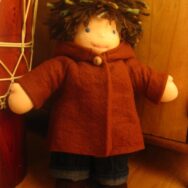
As I wrote last week, creating a natural playroom doesn’t happen overnight. Taking the longer route, while perhaps more realistic, is not without its bumps and setbacks. Here’s a little about what you can expect and some tips to help along the way: It’s no secret that kids don’t actually need a bunch of fancy toys, but unfortunately, I’ve also observed that given the choice, they just can’t resist the shiny, plastic, battery operated, noisy, walking, talking, lights-flashing ones. When you first start to introduce natural toys you may find, like I did, that they aren’t played with as much as you’d hoped. Despite observing the kids in a Waldorf Kindergarten regularly play with rocks and acorns and silks, I have a hard time imagining my kids choosing horse chestnuts and pine cones over a bucket of Lego, given the choice. And it’s not just the rocks that pose this problem. At first even the more exciting toys like the wooden castle filled with wooden horses and knights were only played with when they were brand new and often sat in the corner after that. So, you probably wonder what has worked for us? First off, don’t get discouraged. Keep buying natural toys whenever you can. Make it a priority to invest in these types of toys even if your initial efforts aren’t the raging success you were hoping for. Pool cash gifts from family and friends to get a big item or suggest that family members go together to purchase something you’ve been dreaming of. We started getting the kids some of the bigger ticket items every time a birthday or Christmas rolled around. We started with a beautiful wooden castle and eventually got each of the kids their own Waldorf doll. Expect that as you start getting more of them, there will be a shift. Expect that it will take a while, especially if finances are a big factor. Here are some ways to cut down on the expense: Try making stuff. The woman who did up this room for her son says she got very DIY and made a lot of the toys. Some of the things that we’ve made for our kids include a wooden doll bed, some doll clothes, felt birthday crowns, a wooden sword, and a knight’s tunic. I also have a book that shows how to make simple felt animals which I intend to do with Rain. A lot of etsy vendors even sell patterns for making your own felt food and you can get cheap plain silk and dye your own play cloths. Involving your kids in the process is a good way to ensure that they will be more willing to play with the creations too. Evaluate what big items you really want to purchase and what could be skipped. Do you really need those expensive play arches (even though they are cool)? It seems to me that you could invest in a lot more TOYS to be played with rather than the fancy shelves. Could you make do with a homemade stove/sink combo that sits on a table top rather than an expensive kitchen? Save those purchases until the end when you are really sure that you want/need/can afford them. Two Good Starting Points: Felt Food – I started getting the kids one set of felt play food from etsy for every gift giving occasion. I only spent about $20 at a time, but I did this for Easter, Valentine’s Day, Birthdays and Christmas so they added up quickly. At first they didn’t get used often but as the sets have started to pile up, they now play with them quite a bit. The sets aren’t expensive when you buy them slowly over time like this, and I feel good about supporting handmade etsy products. These make playing with the Fisher Price plastic stuff more fun until we can eventually afford the time/money to either make or buy a kitchen. Dress Up – starting a dress up bin is also a good place to start. This can be done...
Read MoreNatural Playroom Dreams
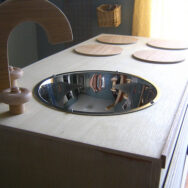
When my son was born, 6 years ago, our consumer culture was in the early stages of the move back to organic, natural products for baby. This included natural crib mattresses without fire retardant in them, homemade baby purees, organic natural fibre clothing and the rising popularity of cloth diapering. Similarly, I started seeing natural toys and wooden toys everywhere. Some expensive baby boutiques that catered to this mindset sprang up around Vancouver and Natural Pod was a new venture that I started seeing at baby themed trade shows like Birth Fest in East Van. I fell in love with the beauty and simplicity of many of the wooden toys and handmade dolls and soft furnishings. Furthermore, in the 3 years between the births of my first two children Canada declared BPA a toxin and banned it from infant feeding products. Our lifestyle began to shift away from plastic and I began to make efforts not to bring more plastic into our home. I envisioned our future playspaces to look like this, and this, and this, and this. A couple of things got in the way of this plan: Money – these natural toys are NOT cheap. Especially some of the bigger items like the wooden kitchen and play arches. I would be willing to save up cash birthday gifts from relatives until we could afford a fancy kitchen like this but Aaron finds them unreasonably expensive toys for kids (despite in my opinion, the obvious care, quality materials and craftsmanship that goes into some of them). Hand-Me-Downs – my sister with older kids gave me a lot of the things they had outgrown and my mom passed down a lot of my old toys from when I was young. My toys had sentimental value plus, being made in the 70’s, they were durable despite being plastic (particularly my old Duplo and Fisher Price sink, stove and dishes). Also, who was I to say no to free toys? Gifts – personally, I think it’s just a bit pretentious to tell people that I only want a certain type of toy for my kids, especially when these toys are also expensive and hard to find. If someone loves my kid enough to buy them a gift, I’m going to smile and say “thank you very much.” When people ask me what my child might like for Christmas or a birthday, I’ve found that the safest answer is “We always love books at our house!” About the only thing I will actually come right out and say is that we prefer not to have clothes or toys with licensed characters on them. Super Cool Non-Natural Toys – over the years, we were occasionally swayed by really cool gifts, or marketing, or our kids’ likes and dislikes, towards things like Lego, Schleich animals and so on. Mindset – to be honest, I think Aaron and I are both unwilling to be so rigidly crunchy as to make this kind of playroom a priority. We probably always will have a few plastic toys and Toy Story puzzles around. Afterall, I don’t think that the majority of non-natural toys are inherently evil (battery operated ones being the exception) so I’m not opposed to having them in the house. Frankly, I’m not wealthy or snobby enough to go all out on creating a natural playroom from scratch overnight. I assume that to be true for most people who admire these types of play spaces. That said, a mostly natural playroom is still something we’re working towards. We’ve had both challenges and successes with this and my intention was to discuss what seems to work in making the slow transition to natural toys…but alas, I blathered on too long again so I will offer that up in my next...
Read More

Recent Comments
No comments to display