


Posts Tagged "The Boy"
Fire Together, Wire Together: Early School Experience

This is Part V of the series Kindergarten Considerations. In this series I am discussing (and wrestling with) the considerations behind the seemingly innocuous decision of where to send my four year old son to school. I promise to share my thoughts on some of our specific options in Part VI. I can’t promise to tell you what we decide because I still have no idea. I’ve been struggling a lot with some of the ideas that came up in my last post for this series. There’s a part of me that wants not to take the idea of registering Rain for Kindergarten so seriously. There’s a part of me that acknowledges that while public school isn’t the ideal learning environment in my opinion, in most cases it isn’t malevolent either. Many (the majority of?) public school teachers are incredibly dedicated and genuinely interested in their students’ success. I did well in public school myself. It is hard not to sound terribly elitist when claiming that public school isn’t good enough for our family. I can imagine the unspoken retort: “It was good enough for all of us and we all turned out fine. Get over yourself.” But I have to balance all of this with the undeniable fact that we are indeed shaped by our experiences. There’s a saying in psychology that neurons that fire together, wire together. Keep in mind that this is a layman’s description (I’m no psychologist) but what this means is that when we do something like painting or math for instance, neurons in certain centres of our brain fire (release neurotransmitters into the synaptic space between neurons) and activate the neurons next to them to fire as well in a sort of chain reaction. Sometimes these are called pathways. Imagine that the more you practice painting or math, the more times you walk down the pathway, you wear in the trail. It gets easier and easier to walk that pathway: you can put down your machete, you’re no longer stumbling and losing your way. Eventually these neurons that fire together, wire together. They create a strong network that fires in unison. This process happens in everything we do, from practicing a skill to overindulging in emotions like anger, and it actually shapes our brains. Unused pathways whither away. Frequently travelled pathways become like super-highways. Melodie from Breastfeeding Moms Unite left a comment on a recent post in this series that really startled me into thinking about this topic in a new way. I had all of the info to make this leap myself but it wasn’t until I read her comment that it all clicked. I know that I am a direct product of my education. I am very concrete and literal, and have a need to get things Right. It’s not something I want to pass on to my kids. I’ve always thought that I did well in school because my brain happens to be organized in the way that the school system is organized. My linear, chronological brain is perfectly in line with a linear, chronological, orderly school system, right? My husband with his right-brain, lateral, spatial thinking is one of the ones who struggles in this set up, right? This is partly true. But wait a minute, according to “neurons that fire together, wire together,” according to Dr. Siegel’s TED talk on how over-emphasis on academics actually changes the architecture of the brain, I am actually a product of our school system. Yes, I probably had an advantage in the beginning because I do have a preference for linear thinking. But over the years, the school system wore that pathway deeper and deeper into my brain’s structure. I see myself in Melodie’s quote above. I think sheepishly of some of my rigidness, my perfectionism, my inability to go with the flow. I think back to the enrichment program in grade 4 when we did a unit of art appreciation on Marc Chagall and in the end painted our own autobiographical Chagall impression. I think of the other skills I have...
Read MoreKindergarten Won’t Ruin Them

This is Part IV of the series Kindergarten Considerations. In Part I, Independent Thinker, I begin with a discussion of how my son’s personality might fit within the regular school system. In Part II, Factory Model Learning, I look back at my own experience in the public school system. Part III discussed Creativity and Compassion – vital parts of education that are missed in our academic-heavy system. My sister posted this on my Facebook wall this week: Kindergarten won’t ruin Rain. It reminded me how melodramatic, even laughable, the worries and fears of the parent of a four year old headed to Kindergarten can be to others. It seems like sending your baby to Kindergarten is a North American rite of passage, not so much for the child but for the parents. Regardless of what choices we make about Kindergarten, it seems we all worry about sending our babies off into the world. That first day, walking them to the bus or kissing them at the classroom door: it’s one of those epic steps in the whole letting go process. We parents can tend to get a little all-consumed with every decision we make for our kids. We get wrapped up thinking that everything we do will make or break them. We worry they won’t be successful or that we’re dooming them to years of therapy and it will ALL BE OUR FAULT. (Ok, I’m kidding). We do want the best for them and considering the hours they’ll spend in school, it’s understandable that we worry about the decision, even when it doesn’t feel much like a decision, even when it’s just a matter of signing them up at the school down the street because we’re in the catchment area. This worry about our kids is easily compounded when we see our own perceived flaws mirrored in our children. I have a tender spot in my heart when I watch Rain struggle socially. I am hyper-aware of it because it’s been a difficulty of mine for as long as I can remember. Similarly when I think of the ways I feel let down by my schooling, I am extra sensitive about the choices I am making for Rain. Yet, the truth is that I can’t protect him forever. I do have to let him go into the world and make his own way. I can’t assume that my kids will have the same issues as I have. They chart the course of their own lives. Just because Rain is showing signs of shyness in preschool doesn’t mean it is my duty to orchestrate his future to protect him from social anxiety. He is not doomed to share my issues just because he shares half my genes. He’ll certainly never overcome the ones we do share if I never give him the opportunity. Sending Rain to public school, though it isn’t my first choice, could have some positive outcomes. The school is walking distance from our house. We would begin to meet families in our neighbourhood and we could get exercise walking together. French immersion is offered there so Rain could learn a second language at a young age which is important to me. Rain could benefit from some of the structure of public school and we could continue working with him on making friends and on how to join groups of kids at play. Socially, it could be beneficial. I worry about these things but I know that I am looking at the schooling prospects through the perspective of my own unique experience. I have to be open enough to accept that Rain’s experience will be different. My sister is right. Kindergarten won’t ruin him. He will adapt. He will adjust. He may even do well, like I did. And if it doesn’t play out that way? We try something else. In grade 12, when we had to put in our applications for University, when it was time to decide what we were going to be when we grew up, I never thought I’d have a career. That is...
Read MoreCreativity & Compassion

This is Part III of the series Kindergarten Considerations. In Part I, Independent Thinker, I begin with a discussion of how my son’s personality might fit within the regular school system. In Part II, Factory Model Learning, I look back at my own experience in the public school system. I’m not an educational expert or a child development expert. But I am an expert on my own children. I know what my school experience was like and I know a little bit about the options available to my son. I haven’t read as many books as I would like to on the subject. I wish I did know more about education and I certainly don’t want to pass off my opinions in this series as anything other than my thoughts on the subject. Imagine my surprise and pleasure when I started to come across experts who are speaking my language and can back up what they are saying with PhDs and research. Today I want to share with you two such experts. Both of the speeches below address the idea that public schools need to be re-thought and re-structured to meet 21st Century demands. The first is Sir Ken Robinson. His speech, delivered at the TED conference in 2006, discusses how today’s public schools kill creativity. (This is a 20 minute speech but he’s a great speaker and quite funny so it is well worth your time). What struck me the most was the idea that the world is changing at a pace so great that we can’t even envision what it will look like in 60 years let alone know what education our kids will need to be prepared for that world. This makes me think back to grade 7 when they taught us how to draw pictures in computer class using coordinates and DOS. Yes, they were right that we would need to know how to use computers to get jobs in the future, but they were way off the mark in preparing us for that eventuality. They were doing their best to prepare us for an unknown future. What I get from Robinson’s TED talk is that our best hope of preparing our kids for this kind of uncertainty is to teach them not just academic subjects but also to teach them to meet challenges with creativity and ingenuity. Robinson goes on to explain that the present school system was devised as a response to the needs of the Industrial Age. Hasn’t our society changed completely since the Industrial Age? Isn’t it time to revise our school system to meet the challenges of the present day? Not only is the current model inadequate for tomorrow; it is inadequate for today. Our school system is as outmoded today as the horse and buggy or the telegram. It’s time to try something new. Personally, I’m not willing to wait around for the folks in charge to realize that change is needed. I’m going to go looking for alternatives. Just like I did when I looked at the way our culture births and the way we grow our food. It’s not good enough for me anymore to do it the same old way just because that’s how it’s been done for generations. I’ve had enough of the industrial model. The next speech I want to share with you is from Dr. Daniel Siegel. I’m paraphrasing here, but essentially his speech discusses the idea that the school system needs to focus not just on academics (the 3Rs) but also on empathy and compassion and interpersonal skills. (I have seen Dr. Siegel speak before and he was fabulous. This particular video could be better; I found the speech a little disjointed. I do encourage you to have a listen nevertheless). Dr. Siegel is an expert in Interpersonal Neurobiology. Basically this is the study of how our interpersonal relationships actually shape our brain. Neuroimaging has advanced in the last few decades to the point where it is possible for the processing of information by centers in the brain to be visualized directly....
Read MoreFactory Model Learning

This is Part II of a series Kindergarten Considerations on finding a school for Rain. Part I, Independent Thinker was about Rain’s personality. This series was inspired by Amber Strocel‘s post (Lack of) Educational Philosophy and Melody’s post at Breastfeeding Moms Unite called Seven Reasons I’m Sending My Child to Public School and The Three Big Reasons I Wish I Wasn’t. When I was in grade 4, I got the opportunity to leave my regular class once a week to go to a special class called Gifted & Talented. We called it G n’ T. I remember doing logic puzzles and tangrams and some experiments with iodine. I remember it being interesting and a lot of fun. It’s almost the only thing I remember about primary school—other than 5th grade when I had my first male teacher who had B.O. and was abusive. I really liked going to G n’ T. We moved at the end of that school year and I never got the opportunity to do that again. I don’t necessarily think I’m any more gifted than the next person. My husband for instance likely has some level of dyslexia and struggled with reading at school and yet he is much more gifted than I at spatial thinking, problem solving, conceptionalizing in three dimensions, interpersonal communication, public speaking and a host of other things. But me? The reason I got the gifted label in grade 4, was because I am lucky enough that my brain works well in the ways the school system is organized. I have a good memory and I am good at linear thinking, chronological order, retaining facts. As a result, things that come easily to me are reading, writing in the standard essay format, rote memorization and regurgitating information on tests. As you can imagine I did just fine in public school. I even have fond memories. The Type-A part of me loved the desks in neat rows, the structure, the new pack of Laurentian pencil crayons every year, the predicatbility, the worksheets, the smell of textbooks. You wouldn’t think I’d be the person getting all snooty about the failings of the public school system. But here we are. So what’s my problem? My problem is that the school system is set up to make everyone homogenous. My impression of school was that everyone was bored. Whether a C student or a straight A student, we were all bored. To this day, my husband still says he didn’t really know why he was there. How is it that despite the fact that I was supposedly “gifted,” there was only 1 year out of 13 years of schooling where the system did anything at all to make sure that I wasn’t bored? How is it that my husband who disliked reading got through highschool without reading a single book? How is it that my friends who struggled with math would not get extra help from the school and had to get tutors on their own? I coasted through highschool. I didn’t learn project management or time management. I didn’t learn good study habits. I didn’t learn about self-directed learning – you know, getting fired up by an idea and choosing to find out more about it? I didn’t learn any of the skills that would have helped me be succesful in University. I learned to do the bare minimum in order to get the grade I wanted. Nothing more. I learned that if I paid half-attention in class, I could spit out the facts on the test and get good grades. I learned that the goal was grades. I didn’t even realize until years afterwards that learning should be fun. I suppose the question is whether educators agree that learning should be fun. The question is: what do we think public schooling is meant to do? Clearly I think it should have done something different. I really think that public school did me a disservice. I think it did my husband a disservice. I want something different for my kids. I think kids naturally...
Read MoreMake a Laptop
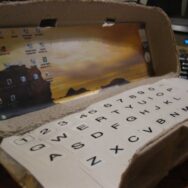
I’m not much of a kids crafter kind of person. My son usually likes to just do whatever he wants with the materials and takes over completely if there is any kind of agenda. For the most part we just let him do what he wants with the art materials which is usually to cut great wads of paper into tiny pieces, spread them around, declare the craft finished and refuse to put anything in the recycling. We find tiny squares of paper spread through the house for weeks afterwards and there is usually a sizable stash stored in Rain’s nightstand because they are too precious for him to part with. (My family is laughing hysterically right now about how the apple doesn’t fall far from the tree or some other dumb thing about how I used to do that, but whatever. I don’t let him have the tape anyways so I don’t even know what they’re talking about.) I got the idea to make a laptop with him out of an egg carton. Of course, a power struggle ensued about how it was to be done. I won because I’m bigger but that meant that I made the craft and Rain mostly watched so now we have no In-Process pictures for the tutorial. The laptop turned out pretty darn cool. I’ll tell you how it’s done and I won’t even be there to boss you around if you want to do it your way. But really, you can’t make a laptop out of a bunch of cut-up pieces of paper so it would be best if you listened to me. Just sayin. You’ll Need: 1 Egg Carton (empty) Scissors Glue Tape Paper 1 Piece of cardstock or thin cardboard I had just received a labeller as a gift from my husband for doing the books and marketing all year for our business. I have a secret stationary/office suply habit so the labeller was like giving me crack. Pretty sweet of him. The laptop would be the first labeller project. Rain also adores the labeller because of all the tiny buttons and portability. It’s like a kid sized computer. Heck, it’s like a laptop. That’s where the power struggle started. He likes to do everything himself. He drops things a lot. I don’t like broken electronics. If broken electronics were a publicly traded commodity, we’d be one of the top shareholders. Enough is enough. You’ll need a labeller or you could just use your computer/printer combo. Or I guess you could write letters with your hand and a pen but that seems kind of old-fashioned now doesn’t it? I mean if you could use a labeller or your own hand, what would you choose? First step, open the egg carton and using your scissors or an exacto (if you’re doing this craft while the kids are in bed, which let’s face it, is a better time to do crafts), cut off the 4-5 points that protrude up towards the lid. Cut them so that they are level with the edges. Next, cut the cardstock into a long rectangle the same size as the lower portion of the egg carton. Fit it in place to check if you have the surface flat enough. Some of the edges may need to be trimmed again. Glue in place. Now the fun part!! Copying the pattern on the keyboard, print off large bold letters and numbers. You can even do the arrows and other keys if you are so inclined. I was planning to do all the SHIFT, CTRL, ALT etc keys but started to get stingy when I saw how much label tape we were going through. I did start to relax though and let Rain press the keys, the print button and use the tape cutter. The labeller was great because we could just cut them and stick them on. If you are printing them on paper, you’ll need to use glue. I hope you don’t get carpel tunnel from not having a labeller for this craft. Especially if you are...
Read More

Recent Comments
No comments to display